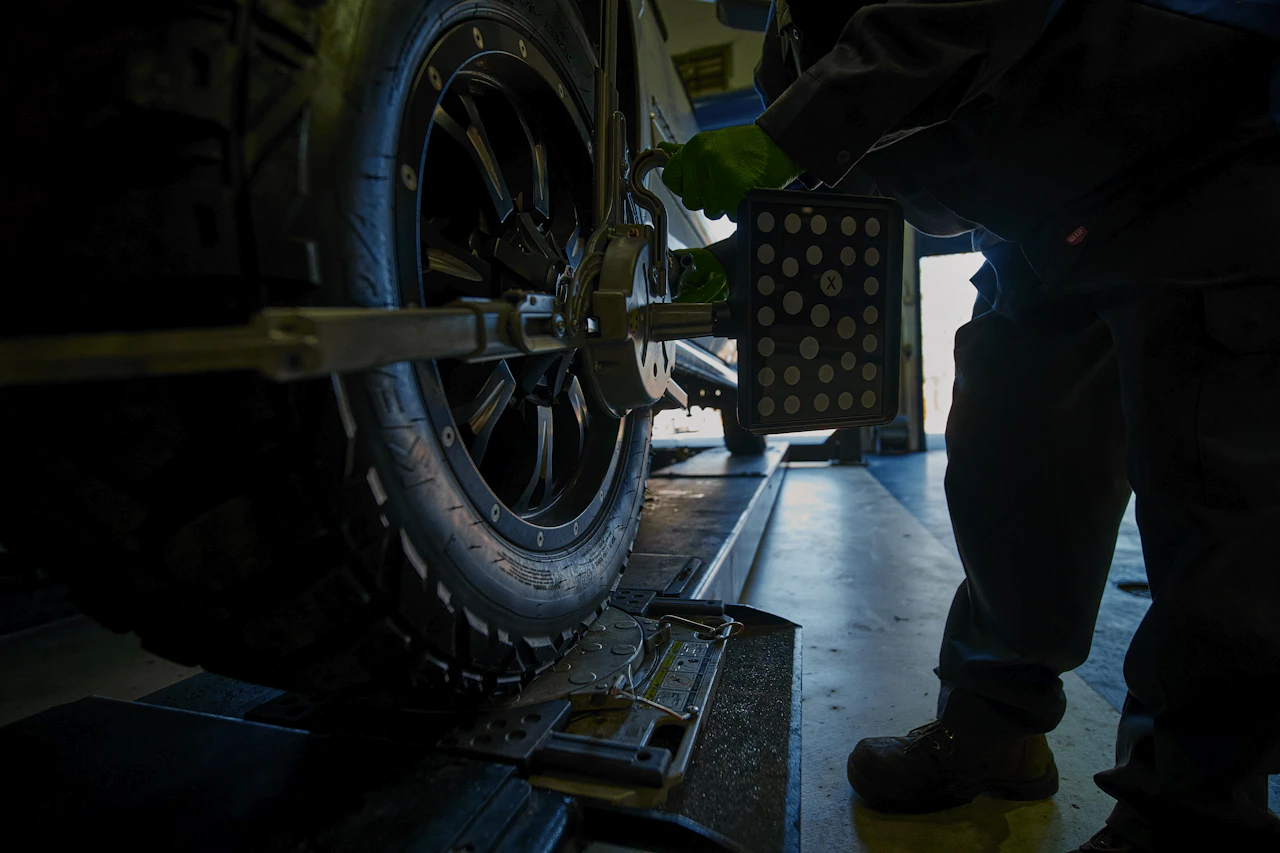
When your truck starts pulling to one side, or your steering wheel feels just a little off-center, it’s easy to shrug it off. Shrugging it off will only make issues worse. In fact, continued misalignment drains your fuel budget, chews through expensive tires, and stresses your suspension every mile you drive.
Proper heavy-duty truck alignment services are essential. Let’s break down how alignment protects your fuel efficiency, tire life, and suspension system, and why it should be part of your regular maintenance plan.
What Is Heavy-Duty Truck Alignment?
In simple terms, alignment ensures your wheels meet the road at the correct angles. For heavy-duty trucks, that means carefully adjusting three primary alignment angles:
- Toe: Toe refers to the inward or outward angle of the tires when viewed from above, and improper toe settings can cause rapid tire wear and reduced fuel efficiency due to increased rolling resistance.
- Camber: Camber is the inward or outward tilt of the tire when viewed from the front, and incorrect camber angles can lead to uneven tread wear and added stress on suspension components.
- Caster: Caster is the forward or backward tilt of the steering axis when viewed from the side, and proper caster settings help maintain straight-line stability, steering control, and overall driving comfort.
Each angle affects how your truck handles, how evenly your tires wear, and how efficiently your driveline transfers power to the road. When these angles fall out of specification, your truck no longer rolls smoothly. Instead, it drags, scrubs, and resists forward motion. That resistance costs you money.
How Misalignment Impacts Fuel Efficiency
Fuel costs always add up, and for owner-operators or fleets, it’s one of the largest operating expenses. Even minor misalignment increases rolling resistance. When your tires don’t point straight or sit flat on the road, your engine has to work harder to keep the truck moving.
Your diesel engine already generates power through a precisely timed four-stroke combustion cycle involving pistons, crankshafts, fuel injectors, and valves. That power flows through the transmission and driveline to turn your wheels. But if your wheels fight that motion due to improper alignment, you’re wasting usable mechanical energy.
The result?
- Lower MPG
- Increased engine load
- Higher operating temperatures
- Reduced overall efficiency
Over thousands of miles, even a small drop in fuel economy adds up to serious cash.
Uneven Tire Wear Caused By Misalignment
Tires for heavy-duty trucks aren’t cheap. When alignment drifts out of spec, your tires begin to wear unevenly. You might notice:
- Feathering along tread edges
- One-sided shoulder wear
- Cupping patterns
- Rapid inner or outer edge deterioration
Improper toe angles cause tires to scrub against the pavement. Camber issues tilt the tire inward or outward, forcing one edge to carry more weight than it should. Over time, this destroys tread life.
Regular commercial truck alignment helps maximize tire lifespan, improve road contact, and maintain predictable handling. Instead of replacing tires prematurely, you get the full mileage you paid for.
Suspension Stress: A Hidden Consequence
Your suspension system does more than keep you comfortable. It supports weight, distributes loads evenly, and absorbs road impacts. Heavy-duty trucks typically use leaf springs or air suspension systems to carry cargo and manage shock absorption.
When alignment is off, suspension components endure uneven stress. That strain accelerates wear on:
- Leaf springs
- Airbags
- Shock absorbers
- Bushings
- Kingpins
Shock absorbers are specifically designed to absorb road impacts and control rebound movement. But when your wheels aren’t aligned properly, they compensate for forces they weren’t meant to handle.
The long-term effect? Premature suspension failure and expensive repairs.
Alignment and Driveline Efficiency
Your transmission and driveline work hard to optimize and transfer engine power. Driveshafts, differentials, axle shafts, and bearings operate under intense torque loads.
When wheels track improperly, added vibration and resistance can place unnecessary strain on:
- Differential gearing
- Bearings and races
- U-joints
- Axle shafts
Bearings, for example, rely on proper lubrication and reduced friction to prevent overheating. Misalignment can increase rolling resistance and heat buildup, which accelerates wear.
Think of alignment as protecting your entire powertrain, not just your tires.
Diesel Truck Control: Keep Optimal Steering and Safety
A properly aligned truck tracks straight and responds predictably to steering input. Misalignment, on the other hand, can cause:
- Steering wheel vibration
- Drifting or pulling
- Poor return-to-center
- Increased driver fatigue
When you’re hauling heavy loads through Bedford Park traffic or navigating tight industrial corridors, you need precise control. Even slight steering instability increases risk, especially in wet, icy, or high-wind conditions. Alignment ensures your truck remains stable, balanced, and responsive.
Signs Your Heavy-Duty Truck Needs Alignment
If you notice any of these issues, scheduling heavy-duty truck suspension repair and alignment should be a priority. Don’t wait for obvious problems. Watch for early warning signs:
- Uneven or rapid tire wear
- Off-center steering wheel
- Truck pulling left or right
- Reduced fuel efficiency
- Suspension noise or looseness
- Vibration at highway speeds
The Role of Preventive Maintenance
Alignment should be proactive. Preventive maintenance for heavy-duty trucks includes regular inspections of suspension components, steering systems, tires, and drivetrain elements.
Fleet managers especially benefit from scheduled fleet truck alignment services, as consistent maintenance keeps multiple vehicles operating at peak efficiency.
Incorporating alignment checks into your preventive maintenance schedule offers:
- Lower long-term operating costs
- Reduced downtime
- Improved tire ROI
- Better fuel efficiency
- Enhanced driver safety
Why Professional Alignment Matters
Improper adjustments can make problems worse. Professional technicians evaluate suspension geometry, axle positioning, and load distribution before making corrections.
Heavy-duty truck alignment isn’t a simple driveway adjustment. It requires:
- Precision measurement systems
- Heavy-duty alignment racks
- Manufacturer specifications
- Skilled technicians
Long-Term Cost Savings Add Up
For owner-operators, that means higher profitability. For fleets, it means predictable budgeting and fewer unscheduled repairs. Instead of reacting to breakdowns or premature tire replacements, you stay ahead of costly repairs.
Let’s look at the big picture. Proper alignment helps you:
- Improve fuel economy
- Extend tire life
- Reduce suspension wear
- Protect driveline components
- Enhance overall safety
Keep Your Truck Rolling Straight
Alignment might not be the flashiest service, but it’s one of the smartest investments you can make. A properly aligned heavy-duty truck runs smoother, burns less fuel, and protects the components that keep you on the road.
If your truck is showing signs of uneven wear or steering issues, don’t ignore it. Schedule professional heavy-duty truck alignment services with Fleet Master Truck and Trailer Repair in Bedford Park, IL, today. Your fuel tank, tires, and suspension will thank you. For more information, read our article on seven signs your truck needs alignment.
.svg)
.svg)
.svg)